Your smartphone’s expiration date was stamped on it before you even unboxed it. And it wasn’t an accident.
Every year, the pattern repeats. Your phone slows down. Battery life shrinks. Apps crash more frequently. That device you spent hundreds or thousands of dollars on suddenly feels obsolete.
But here’s what tech companies don’t advertise: this decline wasn’t inevitable. It was engineered into the product from day one.
The Hidden Truth About Planned Obsolescence
Planned obsolescence is the deliberate design of products with limited lifespans to drive repeat purchases. While the practice has existed for nearly a century, smartphones have become its most profitable playground.
Research from Bocconi University reveals that one in three smartphones in Italy is replaced within a few years, often while still fully functional. The problem extends far beyond physical wear and tear.
A 2025 study examining smartphone replacement patterns found that software-related limitations and repairability gain prominence in newer smartphone generations, even as material durability improves. Translation: manufacturers have simply shifted their obsolescence tactics from hardware to software.
How Your Phone Was Designed to Fail
Smartphone companies employ multiple strategies to ensure your device has a predetermined shelf life.

Battery Degradation by Design
Lithium-ion batteries naturally degrade over time, but manufacturers know exactly how long they’ll last. According to battery performance data, most phone batteries lose about 20% capacity after 500 charge cycles.
For the average user charging daily, this translates to roughly 18 months before noticeable battery problems emerge. Research shows 47% of smartphone failures occur in the first two years of use, with battery issues accounting for 42% of all problems.
Apple’s own specifications state that iPhone 14 models and earlier batteries retain 80% capacity at 500 cycles, while iPhone 15 models achieve this at 1000 cycles. For daily users, this translates to noticeable battery decline within 18-24 months of purchase.
Software Updates That Slow You Down
Perhaps the most controversial obsolescence tactic involves software throttling. In what became known as “Batterygate,” Apple faced legal action across multiple countries for deliberately slowing older iPhones through software updates.
France fined Apple €25 million in February 2020 for failing to inform consumers that iOS updates would slow device performance. Italy imposed a €10 million fine for dishonest commercial practices related to updates causing serious malfunctions.
The pattern isn’t unique to Apple. Research indicates that functional obsolescence is positively associated with device longevity, as many users tolerate performance issues rather than upgrading immediately. Manufacturers exploit this tolerance by gradually degrading performance through updates.
Related: The Right to Repair Movement: Can You Really Fix Your Own Smartphone?
Repair Impossibility
Modern smartphones are deliberately designed to resist repair. According to iFixit repairability scores, most flagship devices score between 4 and 7 out of 10 due to proprietary screws, glued components, and integrated parts.
Fairphone consistently achieves perfect 10/10 scores, proving that repairability doesn’t compromise functionality. Yet major manufacturers continue using adhesives, non-removable batteries, and parts pairing that restrict independent repairs.
Parts pairing—linking specific components to motherboards through software—represents a particularly insidious barrier. This practice severely limits the ability of independent repair shops to fix devices, forcing consumers toward expensive manufacturer repairs or premature replacements.
The Real Cost: Environmental Catastrophe
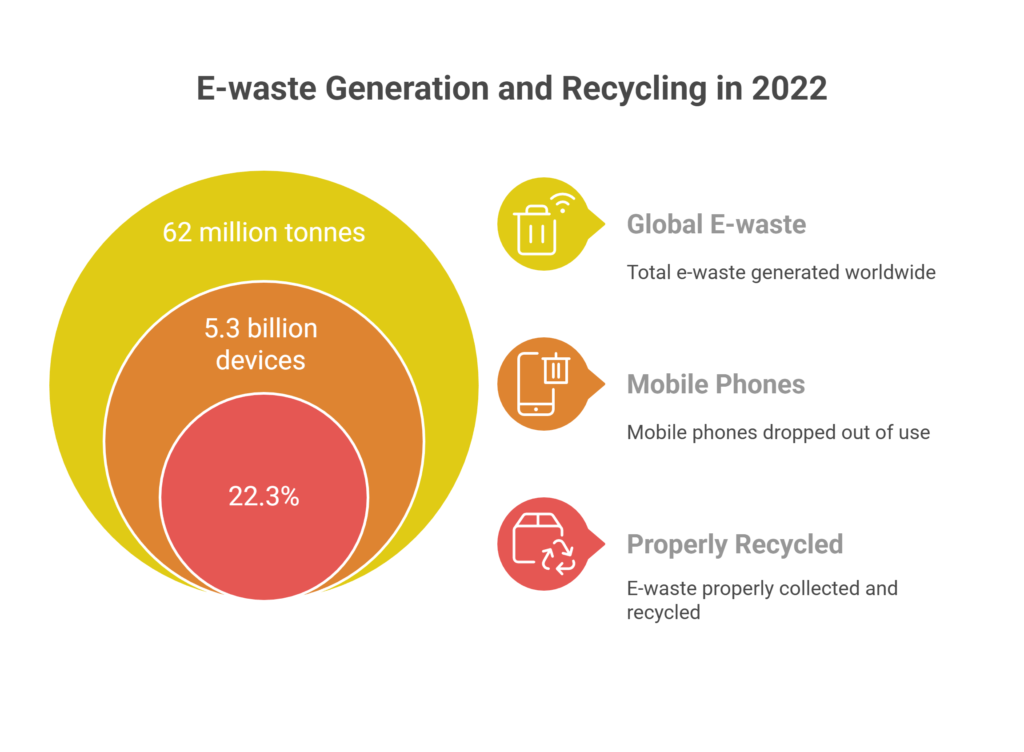
The environmental toll of planned obsolescence extends far beyond individual waste. The United Nations Global E-waste Monitor 2024 reports that global e-waste reached a record 62 million tonnes in 2022, an 82% increase since 2010.
Smartphones represent a rapidly growing share of this waste mountain. Experts estimate approximately 5.3 billion mobile phones dropped out of use in 2022 alone. Stacked together, these discarded devices would reach 50,000 kilometers high—one-eighth of the distance to the moon.
The recycling situation is equally grim. Only 22.3% of 2022’s e-waste was documented as properly collected and recycled, leaving $62 billion worth of recoverable resources unaccounted for.
This represents an enormous economic loss alongside environmental damage. E-waste contains toxic substances including lead, mercury, and cadmium that leach into soil and groundwater when improperly disposed.
Following the Money: Why Companies Do This
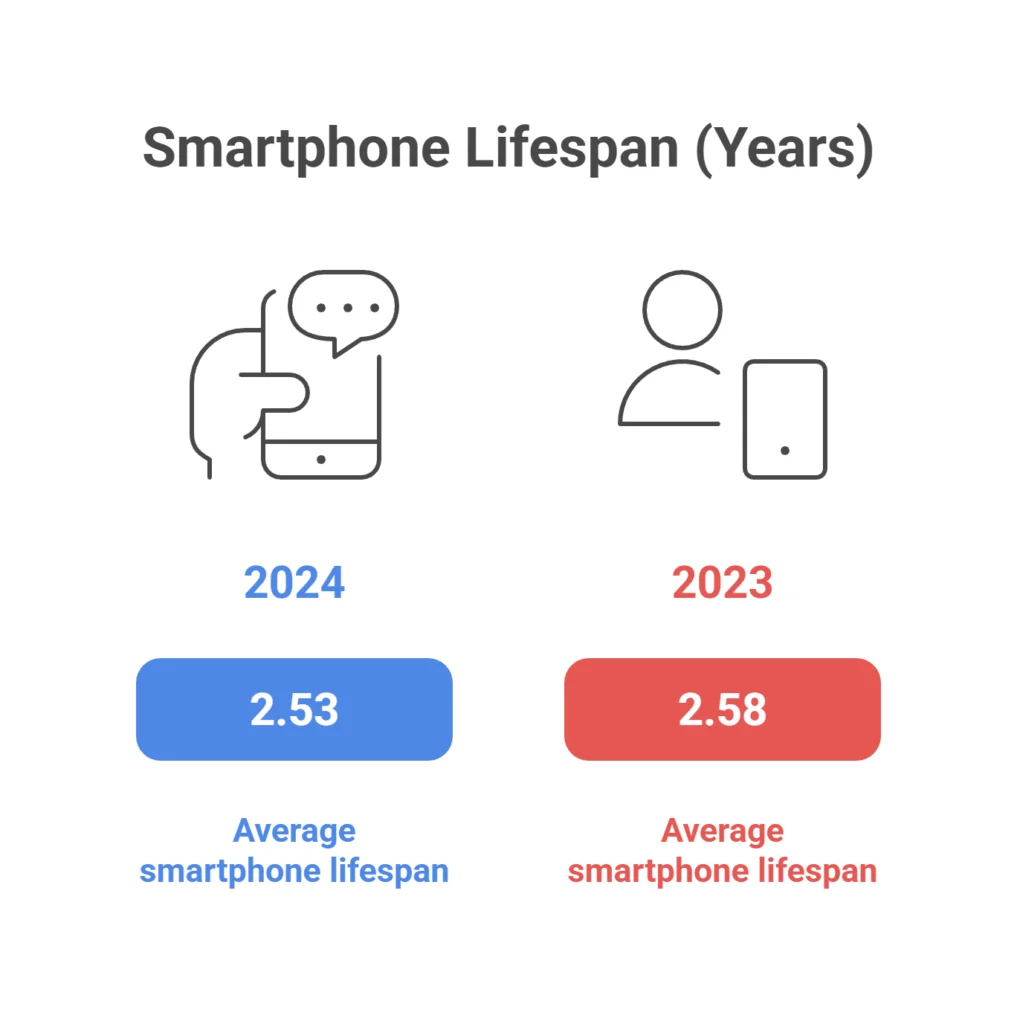
The smartphone replacement cycle drives massive revenue. Current data shows the average smartphone lifespan in 2024 is 2.53 years, representing a 1.9% decrease from 2023.
This accelerating replacement rate isn’t accidental. Industry forecasts predict the average replacement cycle will drop to 2.49 years by 2025, driven by 5G migration and technological advancements.
For manufacturers, shorter lifecycles mean more sales. But consumers pay the price—literally. The difference between desired and actual device lifespan represents a hidden cost, fueling widespread distrust of manufacturers accused of intentionally designing devices with short lifespans.
Psychological Manipulation Drives Upgrades
Beyond technical obsolescence, manufacturers exploit psychological triggers to drive upgrades. Research reveals that psychological and economic obsolescence remain strong drivers of early replacement.
Marketing campaigns create artificial urgency around new features. Trade-in programs make upgrading seem economical. The study found that trade-in programs increase susceptibility to economic obsolescence.
Fashion trends and the desire for the latest technology push consumers to replace perfectly functional devices. The desire for novelty and marketing strategies drive consumers to replace devices long before they are truly obsolete.
The Fightback: New Laws Force Change
European regulators are finally pushing back against planned obsolescence. As of June 2025, new EU ecodesign regulations require smartphones to meet strict durability standards.
Under these rules, smartphones must withstand at least 45 accidental drops without functional impairment and maintain at least 80% battery capacity after 800 charging cycles.
The legislation also mandates that manufacturers supply key spare parts within 5-10 working days for at least 7 years after the product model is no longer sold. Operating system updates must be available for minimum five years.
France’s anti-obsolescence law, implemented since 2015, requires transparency through repairability indexes. The Fairphone 5 scores 9.3 out of 10 on France’s repairability index, demonstrating achievable standards.
The EU’s Right to Repair Directive, entering force in July 2024, extends legal guarantees by one year when products are repaired. It also establishes an online platform helping consumers find local repair services.
Related: Understanding Today’s Major Smartphone Operating Systems
What You Can Do Right Now
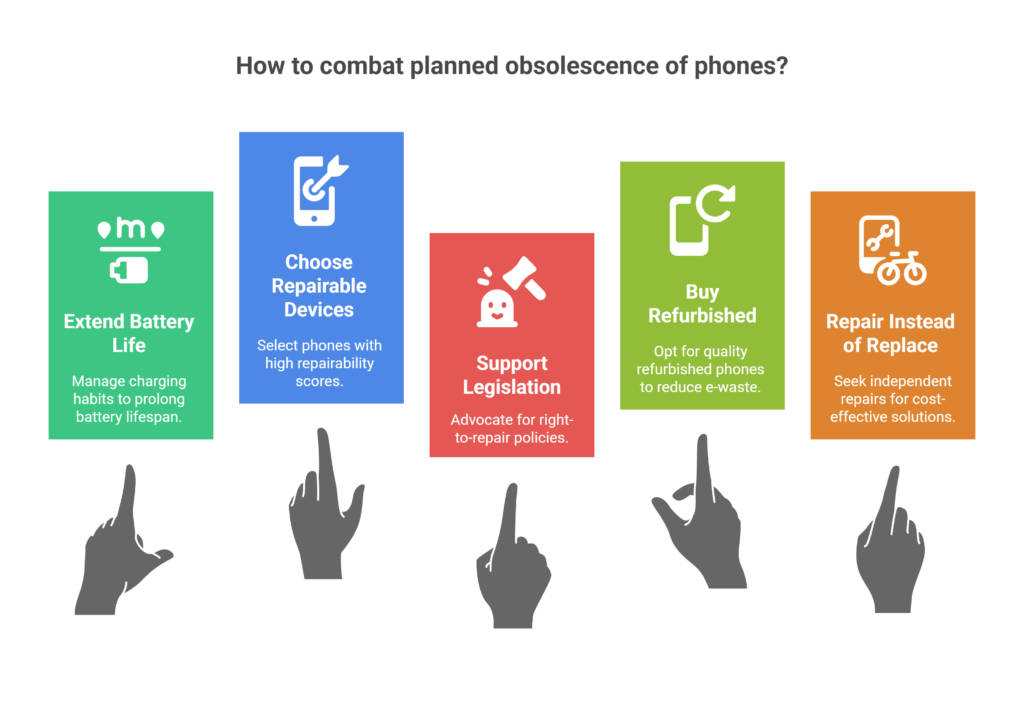
While waiting for regulations to take full effect, consumers can take immediate action to combat planned obsolescence.
Extend your current phone’s life. Keep your device longer by managing battery health carefully. Charge only to 80% and don’t let it drop below 20%. This simple practice can significantly extend battery lifespan.
Choose repairable devices. Research repairability scores before purchasing. Companies like Fairphone prioritize longevity and repair access. Even mainstream manufacturers offer varying repairability—check iFixit scores before buying.
Support right-to-repair legislation. Contact representatives supporting repair-friendly policies. Consumer pressure drove European regulations and can influence policy elsewhere.
Buy refurbished or secondhand. Quality refurbished phones cost significantly less and reduce e-waste. Many come with warranties and perform identically to new devices.
Repair rather than replace. When components fail, seek independent repair shops. Many battery replacements, screen repairs, and component swaps cost a fraction of new device prices.
The Future: A Crossroads for Consumer Electronics
The smartphone industry faces a critical decision point. Current practices generate massive profits but create unsustainable environmental damage and consumer frustration.
Growing awareness of planned obsolescence is changing consumer behavior. The shift in replacement behavior shows that for newer devices, user behavior, brand perceptions, and repair attitudes play a more influential role, highlighting growing consumer awareness around sustainability.
Some manufacturers already demonstrate that durability and profitability aren’t mutually exclusive. Fairphone proves phones can be both highly repairable and commercially viable. The success of these alternatives challenges industry claims that planned obsolescence is necessary.
Regulatory pressure is mounting. Europe leads with comprehensive legislation, but other regions are beginning to follow. These laws force manufacturers to prioritize longevity or face significant penalties.
The next few years will determine whether the industry embraces sustainable practices or continues exploiting planned obsolescence until forced to stop.
Your phone’s death date may have been set at the factory. But how long you keep it—and what you demand from manufacturers—remains in your hands.
Frequently Asked Questions
What is planned obsolescence in smartphones?
Planned obsolescence is the deliberate design of smartphones with limited lifespans to encourage repeat purchases. Manufacturers achieve this through multiple methods including battery degradation timelines, software updates that slow performance, difficult or impossible repairs, and discontinuing support for older models. This practice maximizes profits by creating artificial upgrade cycles rather than allowing devices to reach their natural lifespan.
How long should a smartphone actually last?
Modern smartphones are technically capable of lasting 5-7 years or longer with proper care. However, manufacturer practices limit actual lifespans to around 2.5 years on average. Battery components can last 3-5 years, processors remain capable for even longer, and physical hardware typically outlasts software support. The primary limiting factors are deliberate software restrictions and battery degradation rather than genuine technical obsolescence.
Are manufacturers legally allowed to slow down old phones?
This legal gray area varies by jurisdiction. France fined Apple €25 million for slowing iPhones without disclosure, while Italy imposed a €10 million penalty for similar practices. The issue isn’t necessarily the slowdown itself but the lack of transparency. New EU regulations require manufacturers to disclose performance impacts of updates. In many countries, the practice remains legal if properly disclosed, though consumer protection laws increasingly challenge deceptive implementation.
Can extending my phone’s life really make a difference environmentally?
Absolutely. Extending smartphone lifespans by just one year globally would save carbon emissions equivalent to removing 4.7 million cars from roads by 2030. Each phone’s production accounts for approximately 80% of its total carbon footprint. Keeping devices longer dramatically reduces resource extraction demand, manufacturing emissions, and e-waste generation. With 62 million tonnes of global e-waste generated annually, individual choices collectively create massive environmental impact.
References
- Bocconi. (2025). “Planned Obsolescence and Smartphone Replacement: Empirical Evidence on the Italian Market.” Bocconi University. https://www.unibocconi.it/en/news/disposable-smartphones-trick-planned-obsolescence
- United Nations. (2024). “The Global E-waste Monitor 2024.” https://ewastemonitor.info/the-global-e-waste-monitor-2024/
- WEEE Forum. (2022). “International E-waste Day: Of ~16 Billion Mobile Phones Possessed Worldwide, ~5.3 Billion will Become Waste in 2022.” https://weee-forum.org/ws_news/of-16-billion-mobile-phones-possessed-worldwide-5-3-billion-will-become-waste-in-2022/
- Library of Congress. (2020). “France: Watchdog Agency Fines Apple for Deceitful Practice.” https://www.loc.gov/item/global-legal-monitor/2020-02-28/france-watchdog-agency-fines-apple-for-deceitful-practice/
- European Parliament. (2024). “Right to Repair: Making Repair Easier and More Appealing to Consumers.” https://www.europarl.europa.eu/news/en/press-room/20240419IPR20590/right-to-repair-making-repair-easier-and-more-appealing-to-consumers
- iFixit. “Smartphone Repairability Scores.” https://www.ifixit.com/smartphone-repairability
- European Commission. (2025). “New EU Rules for Durable, Energy-efficient and Repairable Smartphones and Tablets Start Applying.” https://single-market-economy.ec.europa.eu/news/new-eu-rules-durable-energy-efficient-and-repairable-smartphones-and-tablets-start-applying-2025-06-20_en
- Right to Repair Europe. (2023). “New EU Rules: Smartphones and Tablets Will Follow New Ecodesign Requirements by June 2025!” https://repair.eu/news/new-eu-rules-smartphones-and-tablets-will-follow-new-ecodesign-requirements-by-june-2025/
- Fairphone. (2023). “Fairphone 5 Repairability and Sustainability.” https://www.fairphone.com