On January 27, 2026, a group of scientists made an announcement that sent shockwaves around the world. They moved the hands of the Doomsday Clock four seconds forward — from 89 seconds to 85 seconds to midnight. It doesn’t sound like much. But those four seconds represent a major warning: the world is in more danger today than at any point in nearly 80 years of recorded history. To understand why this matters, you first need to understand what the Doomsday Clock actually is — and why scientists use a clock to measure the end of the world.
Key Takeaways:
- The Doomsday Clock is a symbolic warning tool, not a real countdown — midnight represents global catastrophe.
- It was created in 1947 by scientists who helped build the atomic bomb and wanted to warn the public about nuclear dangers.
- On January 27, 2026, the clock was moved to 85 seconds to midnight — the closest it has ever been set.
- The clock is now influenced by nuclear weapons, climate change, artificial intelligence, and biological threats.
- The clock has moved backward before, meaning there is still hope — but scientists say urgent action is needed now.
What Exactly Is the Doomsday Clock?
The Doomsday Clock is not a real clock that measures real time. Think of it more like a warning alarm — a symbolic tool used by scientists to show how close humanity is to destroying itself. The closer the clock’s hands are to midnight, the more danger the world is in.
Midnight on this clock does not mean the stroke of twelve on New Year’s Eve. It represents a global catastrophe — an event so devastating that it could end human civilization as we know it. This could mean a nuclear war, an unstoppable climate disaster, a man-made biological outbreak, or some combination of all of these.
The clock doesn’t tick in real time. Instead, it is reviewed and reset once a year, every January, by a group of experts who look at the state of the world and decide whether humanity is moving closer to — or further from — that catastrophic midnight.
Who Invented It and Why?
The story of the Doomsday Clock begins at the end of World War II, in the aftermath of one of the most terrifying events in human history: the atomic bombing of Hiroshima and Nagasaki, Japan, in August 1945.
The scientists who built those bombs — many of them working across secret research sites including the University of Chicago as part of the top-secret Manhattan Project — were horrified by what they had created. They knew better than anyone just how destructive nuclear weapons could be. So in 1945, just weeks after the bombings, they formed a group called the Bulletin of the Atomic Scientists, dedicated to warning the world about nuclear dangers.
Two years later, in 1947, the Bulletin was being turned from a newsletter into a proper magazine. A co-editor named Hyman Goldsmith asked a landscape artist named Martyl Langsdorf — whose own husband had worked on the Manhattan Project — to design a cover. She chose a clock. She later said she chose that position simply because “it seemed the right time on the page … it suited my eye.” But that simple image became one of the most recognizable symbols in the world.
The founding members and earliest sponsors of the Bulletin included some of the most famous scientists in history, including Albert Einstein and J. Robert Oppenheimer — the man often called the “father of the atomic bomb.”
Does a Physical Clock Actually Exist?
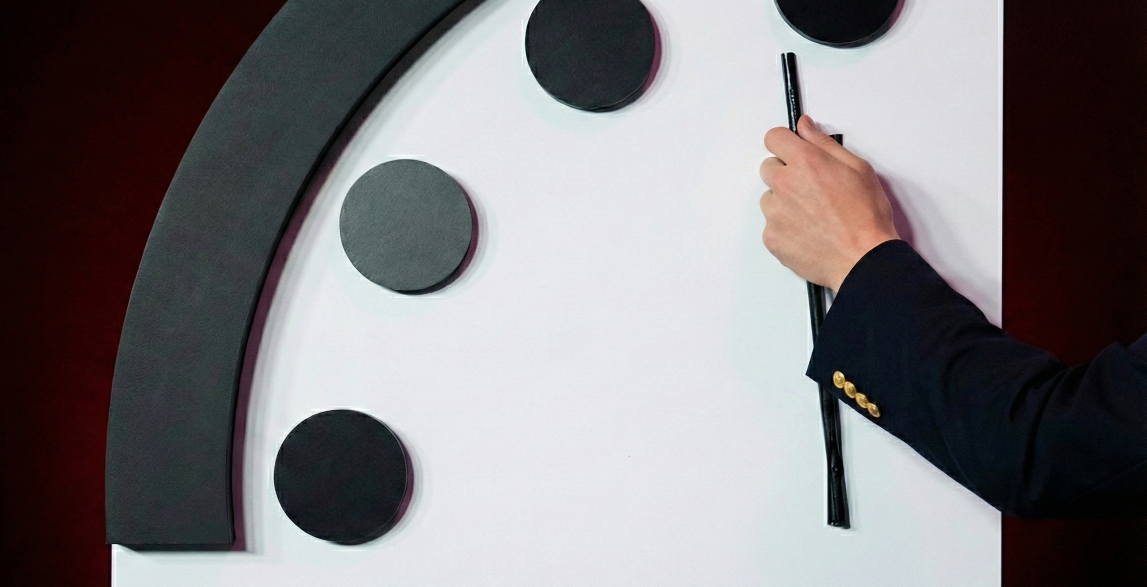
Yes — and this surprises many people. There is a real, physical Doomsday Clock that exists in the real world. It is located in the lobby of the Keller Center at the University of Chicago, which is home to the university’s Harris School of Public Policy.
However, this physical clock is more of a symbolic object than a functional timepiece. The important part is not the clock itself — it’s the announcement that scientists make each January, telling the world where the hands of the clock now stand.
When scientists move the clock forward or backward, they do so at a press conference, adjusting the physical clock’s hands in front of cameras. Those images are then broadcast around the world.
Related: Generative AI: A Practical Guide to Its Real-World Use Cases
Who Decides Where the Clock Is Set?
The clock is set by the Science and Security Board of the Bulletin of the Atomic Scientists — a group of globally recognized experts in nuclear weapons, climate science, artificial intelligence, and biological threats.
This board meets twice a year to review world events and assess risks. Their process is similar to how a doctor makes a diagnosis. As the Bulletin puts it: they look at data — like the number of nuclear warheads in the world, the amount of carbon dioxide in the atmosphere, and the speed at which sea levels are rising — and then make a judgment about what it all means for humanity’s survival.
Their decisions are also reviewed by a Board of Sponsors that includes Nobel Prize laureates, ensuring that the clock’s setting is backed by some of the most respected scientific minds on Earth.
The announcement is made publicly every January. It is not a government decision, not a political decision, and not a military decision. It is purely a scientific judgment based on observed facts and trends.
How Has the Clock Changed Over the Years?
When the clock first appeared in 1947, it was set at seven minutes to midnight. Since then, it has been moved both forward and backward 27 times, responding to world events — for better and for worse.
The Good Times (When the Clock Moved Back)
The most hopeful moment in the clock’s history came in 1991, when the United States and the Soviet Union signed the Strategic Arms Reduction Treaty (START), which drastically cut the number of nuclear weapons both countries held. The clock was moved all the way back to 17 minutes to midnight — the furthest it has ever been from catastrophe.
Other positive moments included international cooperation on nuclear testing bans in the 1960s and progress on arms control and climate talks in the 2010s.
The Dangerous Times (When the Clock Moved Forward)
The clock moved dangerously close to midnight twice before:
- In 1953, after both the United States and Soviet Union successfully tested hydrogen bombs — far more powerful than the atomic bombs dropped on Japan — it was moved to just two minutes to midnight.
- In 2018, amid growing nuclear tensions and the failure of world leaders to act on climate change, it was moved forward again to two minutes to midnight.
Then came a period of rapid deterioration. By 2020, the clock stood at 100 seconds — under two minutes — for the first time ever. By 2023, it was at 90 seconds. In 2025, it moved to 89 seconds. And now, in January 2026, it has reached its all-time record: 85 seconds to midnight.
Related: The Battle for AI Chips: A Guide to the Semiconductor Industry
Why Did the Clock Move to 85 Seconds in 2026?
The scientists at the Bulletin pointed to one overarching cause for the 2026 change: a failure of global leadership. In their official statement, they wrote that major countries — including Russia, China, and the United States — have become increasingly aggressive, nationalistic, and adversarial, while international cooperation has collapsed.
Here are the main threats that pushed the clock forward this year:
Nuclear Weapons Are More Dangerous Than Ever
For the first time in more than 50 years, there is no major treaty limiting nuclear weapons between the United States and Russia. The New START Treaty — which had placed caps on how many nuclear warheads each country could deploy — expired on February 5, 2026, with no replacement in sight.
“For the first time in over half a century, there will be nothing preventing a runaway nuclear arms race,” said Daniel Holz, a University of Chicago professor and chair of the Science and Security Board.
The scientists also noted that during 2025, three different military conflicts were taking place that involved nuclear-armed nations, raising the risk that a miscalculation or accident could lead to nuclear use.
Climate Change Continues Unchecked
The Earth has experienced its hottest years on record in the last decade, and that trend is continuing. Scientists on the board expressed deep concern not just about rising temperatures, but about the dismantling of climate monitoring systems — the tools we use to measure and respond to climate threats.
Inez Fung, an atmospheric scientist on the board, put it in stark personal terms: she compared the planet’s current state to a seriously ill patient, saying she was worried about the world reaching a critical point — and that the monitoring devices warning us about it are disappearing.
Artificial Intelligence Is Adding New Risks
AI, which means computer systems that can think and learn like humans, was flagged as a growing threat — particularly in military and social media contexts. Scientists noted that AI is increasingly being used in warfare and in spreading disinformation (false information designed to manipulate people), adding new layers of risk that are difficult to control or predict.
Biological Threats Are Growing
Scientists also flagged growing concerns about the misuse of biotechnology — particularly the possibility that AI could be used to help create dangerous biological threats. There is currently no international framework in place to address these emerging risks.
Should We Actually Be Worried?
This is the question most people ask — and it deserves an careful, honest answer.
The Doomsday Clock is not a prediction. The scientists who set it are very clear about this. The clock does not say that the world will end, or that midnight is inevitable. It shows where we are right now based on current trends, as a warning to motivate action.
Alexandra Bell, president and CEO of the Bulletin, said it clearly: “The clock does not predict the future. It illuminates our current reality. The clock has turned back before. And it can again.”
What the clock does tell us is that the combination of nuclear risks, climate change, AI, and biological threats — all happening at the same time, with leaders seemingly unable or unwilling to cooperate on solutions — has created a level of danger the world has not seen before.
At the same time, some critics argue the clock is overly alarming. Cognitive psychologist Steven Pinker has called it a political stunt, noting that the clock remained at seven minutes to midnight throughout 1962’s Cuban Missile Crisis — one of the most genuinely dangerous moments of the Cold War — yet stood closer to midnight at five minutes in the far calmer 2007. This highlights a fair critique: the clock reflects the Bulletin’s expert judgment, not a mathematically precise measurement.
Still, the Bulletin’s track record of moving the clock backward when things genuinely improved — like after the Cold War ended — suggests it is not purely alarmist. The scientists have shown they are willing to report good news when there is good news to report.
Related: AI Assistants 2025: ChatGPT vs Gemini vs Claude vs Perplexity
Can the Clock Move Backward Again?
Yes — and this is perhaps the most important thing to understand. The clock is not a death sentence. It is a tool designed to spur action, not despair.
The Bulletin has outlined concrete steps that could push the hands back:
- The United States and Russia can restart talks on limiting their nuclear weapons stockpiles.
- All nuclear-armed countries can stop investing in destabilizing missile defense systems and respect existing agreements against explosive nuclear testing.
- The international community can work toward meaningful guidelines on the use of AI in warfare and multilateral agreements to address the development of dangerous biological technologies.
- Governments can accelerate the transition away from fossil fuels that drive climate change.
The Bulletin’s belief — built into its very mission — is that because human beings created these dangers, human beings can also solve them. “The clock is really a metaphor for the amount of danger that we’re in,” said Alexandra Bell. “But it’s also a call to action. We have time left to fix the problems we ourselves have created.”
Conclusion
The Doomsday Clock is one of the most powerful warning signals ever created. Born from the conscience of the scientists who built the atomic bomb, it has spent nearly 80 years telling the world the truth about how close we are to catastrophe. At 85 seconds to midnight, it is now closer to that catastrophe than ever before in history. But the scientists who set it are also clear: midnight is not inevitable. The clock moved forward because of human choices — and it can move backward for the same reason. The question is whether the world’s leaders, and the world’s citizens, are paying attention.
Frequently Asked Questions
Is the Doomsday Clock officially recognized by any government?
No — the Doomsday Clock is set by the Bulletin of the Atomic Scientists, a private nonprofit organization. No government controls it or officially endorses it. However, it is widely cited by world leaders and taken seriously by policymakers, scientists, and international organizations as a credible warning signal.
Could the Doomsday Clock ever reach midnight?
The scientists who set the clock say they hope it never does. Reaching midnight would mean a global catastrophe has already occurred — such as a nuclear exchange or irreversible climate collapse that has made the Earth uninhabitable. The clock exists precisely to prevent that from ever happening.
How is the Doomsday Clock different from other threat assessments?
Most government threat assessments focus on specific, near-term risks in individual countries or regions. The Doomsday Clock is unique because it looks at long-term, civilization-level threats — nuclear war, climate change, AI, and biological dangers — all at the same time, from a global perspective. Its goal is not to predict a specific event but to show the overall direction humanity is heading.
References
- Bulletin of the Atomic Scientists, 2026 Doomsday Clock Statement, 2026
- Wikipedia, Doomsday Clock, 2026
- CNN, Doomsday Clock 2026: Atomic scientists set new time, 2026
- NBC News, Atomic scientists set ‘Doomsday Clock’ closer to midnight than ever, 2026
- University of Chicago News, Doomsday Clock ticks down to 85 seconds to midnight in 2026, 2026
- Britannica, Doomsday Clock | Definition, Timeline & Facts, 2026
- Bulletin of the Atomic Scientists, Doomsday Clock FAQ, 2026