
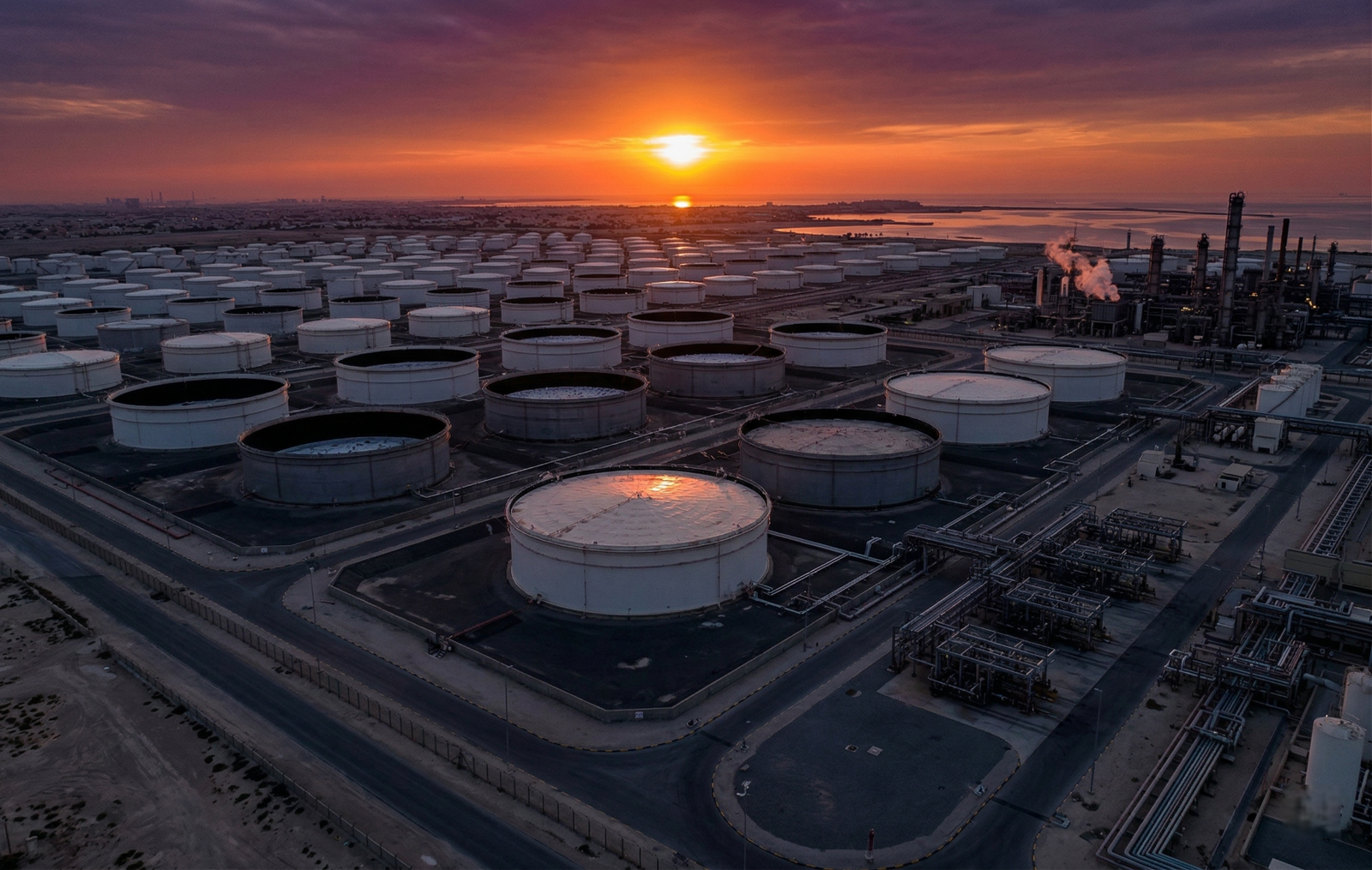
Oil powers almost everything in modern life — the trucks that move food, the planes that carry people, the ships that carry goods across oceans, and the factories that make nearly everything we buy. Most people assume this supply is always flowing. But what happens when it isn’t? Governments around the world have prepared for exactly that moment, building vast emergency oil stockpiles known as Strategic Petroleum Reserves. This article explains what those reserves are, how they work, who holds them, and — most critically — how long they could realistically sustain the world if oil production were suddenly cut off.
Key Takeaways:
- A Strategic Petroleum Reserve is a government-controlled emergency stockpile of crude oil, held separately from commercial supplies.
- The global system is a network — each country holds its own reserve, and in a crisis, they can release simultaneously in a coordinated action.
- The world consumes roughly 100 million barrels of oil per day — meaning total global strategic reserves would last approximately 30 days if all production stopped.
- These reserves were never designed to replace production — they are designed to buy time.
What Is a Strategic Petroleum Reserve?
A Strategic Petroleum Reserve is an emergency stockpile of crude oil held by a national government — stored separately from commercial oil supplies and reserved specifically for crises. Think of it like a national emergency savings account, except instead of money, it holds oil.
The core idea is straightforward: if something disrupts a country’s oil supply — a war, a natural disaster, a political embargo, or a blocked shipping route — the government can release oil from this reserve to keep the economy running while the underlying problem is resolved. The reserve is not meant to power the country forever. It is meant to buy enough time for the crisis to pass.
Where Did This Idea Come From?
The modern system of strategic petroleum reserves was born from a specific disaster. In 1973, the Organization of Arab Petroleum Exporting Countries (OAPEC) cut off oil supplies to nations that had supported Israel in the Yom Kippur War — including the United States, the United Kingdom, Japan, Canada, and the Netherlands. The impact was immediate and severe — fuel shortages, rationing, long lines at petrol stations, soaring prices, and economic disruption across Europe, North America, Japan, and beyond. Countries that had no stored emergency oil had no buffer. They were completely exposed.
The lesson was clear: any country that depends on imported oil — which is most of the world — needs an emergency cushion. The International Energy Agency was founded in 1974, specifically to coordinate energy security among wealthy nations. One of its founding rules was that every member country must hold emergency oil stocks equal to at least 90 days of their net oil imports.
How the Global Reserve System Works
There is no single global strategic reserve. Instead, the system works as a network: each country stores its own oil, within its own borders, in whatever type of facility suits its geography. In a major international crisis, the IEA can call all its members to release simultaneously — creating a coordinated global response made up of parallel national actions.
Government Stocks vs. Industry Stocks
Most countries run a two-layer system. The first layer is government-owned oil, stored in dedicated facilities and only released by official government decision. The second layer is oil held by private energy companies under legal obligation — the government can order this released in emergencies too. Together, these two layers form a country’s total strategic reserve capacity.
How Reserves Are Released
Releasing reserve oil is a formal process, not an automatic one. In most countries it requires a decision at the ministerial or head-of-state level. Once authorized, the crude oil moves through pipelines or tankers to refineries, where it is processed into usable fuels — gasoline, diesel, jet fuel, heating oil. This refining step takes additional time. After refining, fuel must still be distributed through commercial channels to reach consumers.
From the moment a government authorizes a release to the moment that oil reaches a petrol station, the total process typically takes several weeks. This is important to understand: emergency reserves do not instantly lower fuel prices at the pump. They work gradually, through normal market channels.
The Oil Goes to Market, Not Directly to Consumers
When governments release reserve oil, they typically sell it through competitive auction to refineries and energy trading companies. Those buyers then process and distribute it commercially. The reserve adds supply to the market; it does not bypass the market. This is by design — it ensures oil flows quickly to wherever it is most needed.
Related: How the U.S. Dollar Became the World’s Most Powerful Currency
Who Holds Strategic Reserves — and How Much?
Strategic petroleum reserves are held by dozens of countries across the world, ranging from large economies with hundreds of millions of barrels to smaller nations with just a few weeks’ worth of domestic consumption.
IEA Member Countries
The IEA’s 32 member countries — primarily wealthy nations in Europe, North America, East Asia, and Oceania — collectively held approximately 1.8 billion barrels of strategic reserves as of early 2026. This includes both government-owned stocks and privately held obligated stocks. Member countries include the United States, Japan, Germany, France, the United Kingdom, South Korea, Italy, Canada, Australia, and others.
IEA members are required to hold at least 90 days of their net oil imports in reserve. In practice, many hold significantly more. Japan, for example, held reserves equivalent to roughly 254 days of its domestic consumption as of end-2025 — reflecting its near-total dependence on imported oil and its vulnerability to disruptions in Middle Eastern supply routes. South Korea holds approximately 208 days. Most European nations hold between 100 and 200 days of net import coverage.
China — The World’s Largest Single National Reserve
China is not an IEA member and does not publish detailed data about its stockpiles. However, By 2026, independent estimates placed China’s total strategic and commercial oil inventories at approximately 1.1 to 1.5 billion barrels — with some analysts putting the figure higher — making it the largest single national stockpile in the world. China has been aggressively expanding its reserve capacity, adding new storage sites and increasing stockpiles as its economy’s dependence on imported oil has grown.
India, South Korea, and Other Major Holders
India maintains its own strategic petroleum reserve, managed by the Indian Strategic Petroleum Reserves Limited. Its current capacity covers approximately 10 days of national consumption — a relatively thin buffer for one of the world’s largest oil importers, though expansion plans are underway. South Korea holds substantial reserves exceeding 200 days of import coverage. Singapore, a major global oil trading and refining hub, holds significant strategic and commercial stocks relative to its size.
Russia and Middle Eastern Producers
Countries that produce and export large amounts of oil — Russia, Saudi Arabia, the UAE, Iraq, and others — generally do not maintain strategic reserves in the same way. As net exporters, they have access to production rather than needing stored emergency supplies. Their “buffer” is spare production capacity — the ability to pump more oil if prices spike.
The Critical Question: How Long Would Reserves Last?
This is the number that puts the entire global reserve system in perspective.
Global Daily Oil Consumption
The world currently consumes approximately 100 million barrels of oil every day. This covers all uses across all countries: transport fuel for cars, trucks, ships, and aircraft; heating and industrial energy; petrochemicals used to make plastics, fertilizers, medicines, and materials; and electricity generation in countries still dependent on oil-fired power plants.
Total Strategic Reserves vs. Daily Consumption
As of early 2026, the best available estimates of global strategic petroleum reserves — combining IEA member government stocks, obligated industry stocks, and estimates for major non-IEA holders like China — suggest a total of approximately 3 to 4 billion barrels worldwide.
At global daily consumption of 100 million barrels, that total would last:
- IEA government stocks alone (~1.2 billion barrels): roughly 12 days
- All IEA stocks including obligated industry stocks (~1.8 billion barrels): roughly 18 days
- All global strategic stocks including China and others (~3–4 billion barrels): roughly 30 to 40 days
In other words, if global oil production were to completely and suddenly stop, the world’s entire emergency stockpile system would be exhausted in about one month.
Why Individual Countries Fare Differently
The “days of supply” figure varies dramatically by country, based on how much oil each nation stores relative to how much it consumes:
- Japan: ~254 days (of its own consumption)
- South Korea: ~208 days
- Most European nations: 100–200 days of net import coverage
- India: ~10 days
- China: estimated 120–200 days of net imports (estimates vary significantly due to limited official data)
These figures represent how long each country could sustain itself using only its own reserves if its imports were completely cut off — not how long global production could be replaced.
Related: Understanding Gross Domestic Product (GDP) — and Why It Matters
The Reality: What Reserves Are Actually Designed to Do
Understanding the 30-day figure requires understanding what strategic reserves were built for. They were never intended to replace global production. They were built to do three specific things.
1. Buy Time During Short Disruptions
Emergency reserves are designed to bridge temporary gaps — a hurricane that shuts down offshore platforms for two weeks, a pipeline rupture, a brief political crisis that blocks a shipping route. In these scenarios, a few weeks of reserve supply is often enough to bridge the gap while repairs happen or negotiations succeed.
2. Calm Market Panic
When supply disruptions occur, oil prices often spike far beyond what the actual physical shortage would justify. This happens because traders worldwide panic about future supplies. Strategic reserve releases signal to the market that governments have a buffer — which slows panic-driven price surges, even before a single barrel reaches a refinery. The announcement alone can have an immediate stabilizing effect.
3. Enable International Coordination
The IEA system allows governments to coordinate a collective response to global crises. Instead of each country scrambling independently, a simultaneous multi-country release adds supply to multiple markets at once, amplifying the stabilizing effect. This coordination has been used six times in the IEA’s history: during the Gulf War in 1991, after Hurricanes Katrina and Rita in 2005, the Libyan civil war in 2011, twice in 2022 in response to Russia’s invasion of Ukraine, and again in 2026 in response to the conflict in the Middle East.
What Reserves Cannot Do
Strategic reserves cannot replace a prolonged, large-scale supply loss. The global system holds roughly one month’s worth of supply — not six months, not a year. If a major producing region were taken completely offline for an extended period, no reserve system on earth could sustain normal global economic activity. The world would face mandatory consumption reductions, rationing, and economic contraction long before the reserves ran dry.
This is not a failure of the reserve system. It reflects a deliberate design choice: building reserves large enough to truly replace production would cost trillions of dollars and require storage infrastructure on a scale that no government has pursued. The 90-day IEA standard is a practical balance between cost, storage feasibility, and the typical duration of supply disruptions that reserves are meant to address.
A Note on “Proven Reserves” vs. Strategic Reserves
It is worth clarifying an important distinction that often causes confusion. When news articles discuss the world “running out of oil,” they are usually referring to proven reserves — the total amount of oil that exists underground and can be economically extracted. Estimates of global proven oil reserves vary by methodology — OPEC’s most recent bulletin puts the figure at approximately 1,567 billion barrels, while broader estimates from sources like Worldometer place it closer to 1.77 trillion barrels. Either way, the world has several decades of oil remaining at current consumption rates — roughly 40 to 47 years depending on the estimate used.
Strategic petroleum reserves are something entirely different. They are oil that has already been extracted from the ground, refined or stored as crude, and physically held in government or industry storage facilities ready for immediate release. Strategic reserves are a buffer against supply disruption, not a measure of how much oil remains in the earth.
Conclusion
Strategic Petroleum Reserves represent one of the most important tools of global economic management. They exist in dozens of countries, from large economies holding hundreds of millions of barrels to smaller nations with just a few weeks of cushion. Taken together, the world’s strategic stockpiles hold roughly 30 to 40 days of global oil consumption. That is a meaningful buffer for short-term crises. It is not a replacement for production. The deeper you understand that distinction, the more clearly you can read any energy crisis headline — and understand exactly what governments can and cannot do when the oil supply is threatened.
References