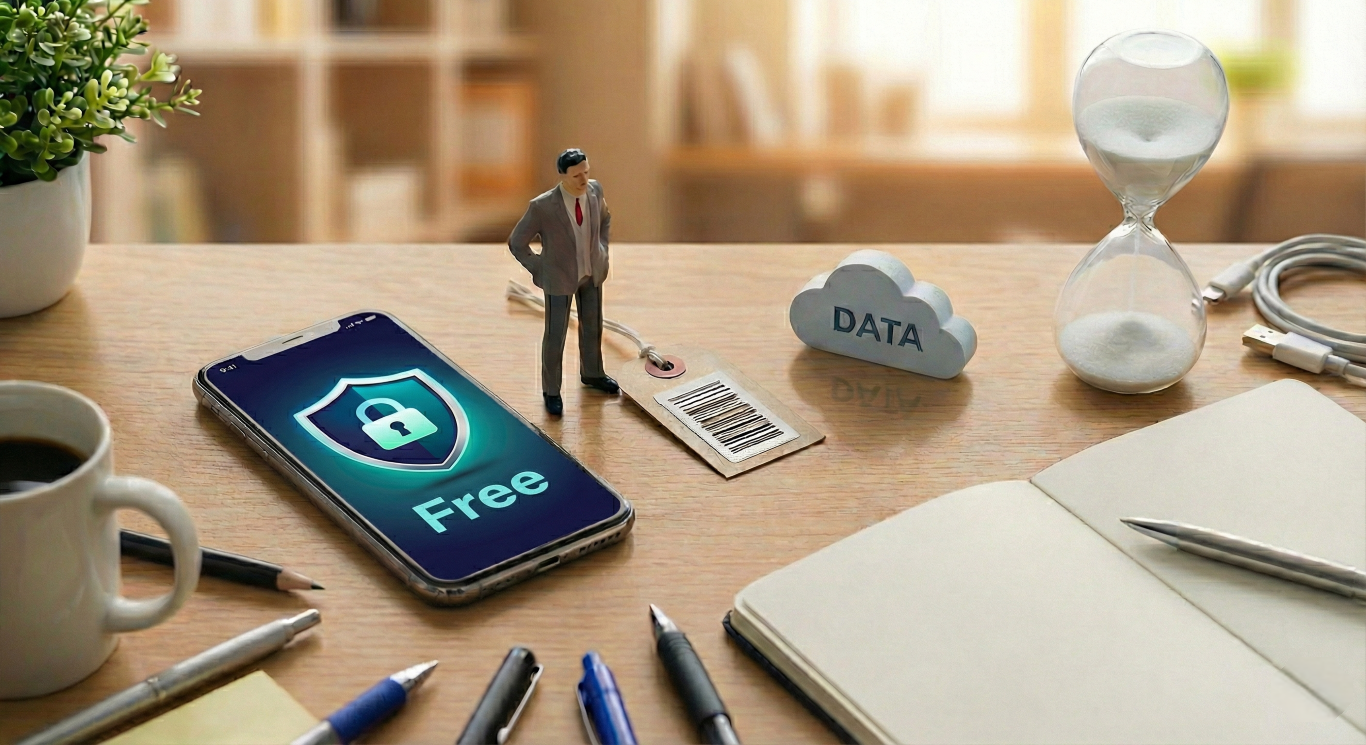
Every time you download a “free” app, you’re making a deal. You’re just not the one getting paid.
Key Takeaways
- Research from Tenscope reveals that 75% of top free apps actively track users across websites and apps for advertising purposes
- Facebook and Instagram each collect 156 individual data points directly linked to user identities, according to a 2025 study
- The global data extraction market is projected to reach $6.70 billion by 2032, growing at 11.33% annually
- Three simple privacy rules can dramatically reduce your digital exposure without sacrificing the apps you use
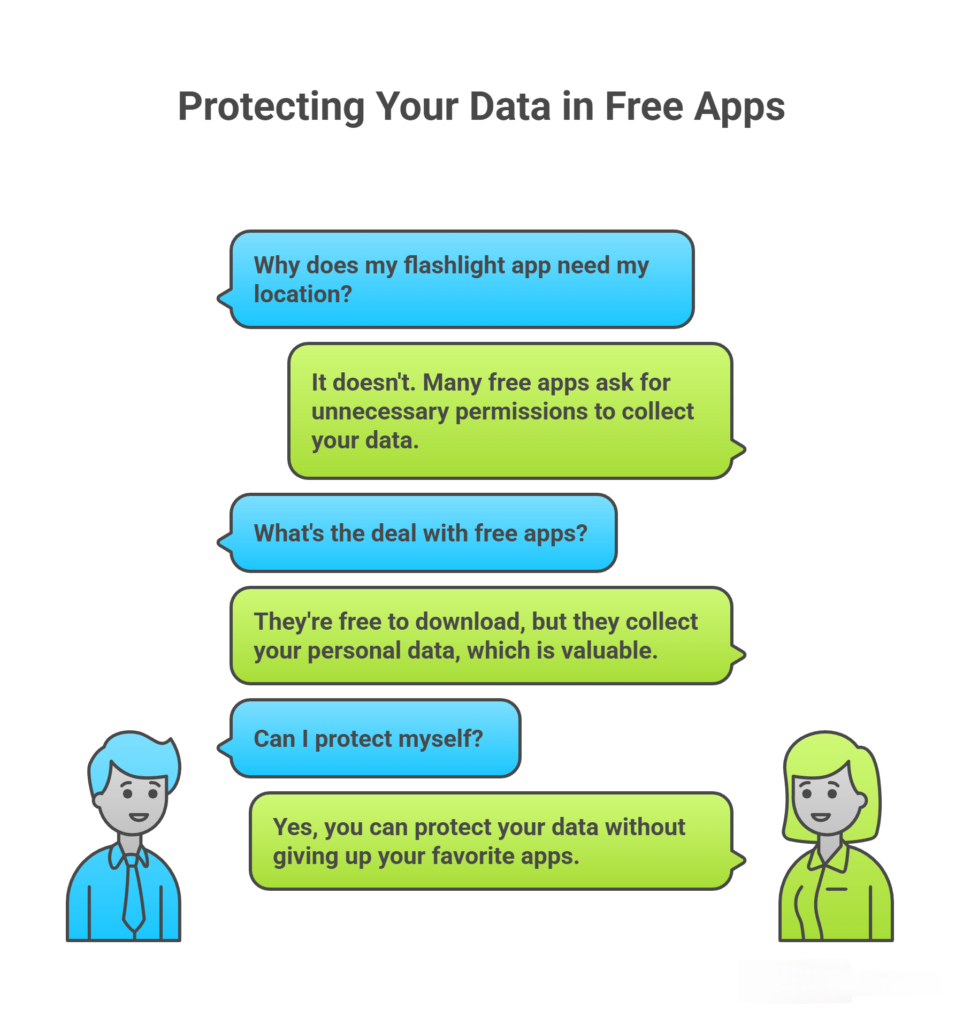
That flashlight app on your phone doesn’t need to know your location. The weather app doesn’t need access to your contacts. Yet they ask anyway—and most of us just tap “Allow.”
Free apps dominate the mobile landscape. According to recent data, 97% of apps in the Google Play Store and 95% of apps in the Apple App Store are free to download. But nothing in life is truly free. When you’re not paying with money, you’re paying with something far more valuable: your personal data.
Welcome to the data extraction economy, where your behavior, preferences, and personal information have become the currency. The good news? You can protect yourself without giving up your favorite apps.
The Hidden Cost of “Free”
Free apps make money through several methods, but data monetization remains one of the most profitable. Research from the 2025 App Privacy Index found that Meta’s Messenger app scored a perfect 100 out of 100 for invasiveness, collecting over 20 times more data than privacy-conscious apps.
The data extraction economy operates on a simple principle: collect everything, sell to anyone. Apps gather behavioral data, browsing history, location information, and demographic details. Third parties purchase this data for targeted advertising, market research, and analytics.
The numbers tell the story. Facebook and Instagram each harvest 156 data points linked directly to your identity. Lyft, the ride-sharing app, ranks as the third most invasive app with a privacy score of 69, collecting more data than Amazon or Google Maps.
This isn’t accidental. Apps use sophisticated tactics to encourage data sharing. The 2025 App Privacy Index identified several deceptive design patterns, including bundling unrelated permissions into single requests and burying privacy settings under multiple menu layers. These “dark patterns” make revoking permissions intentionally difficult.
Related: Is Your Air Fryer Watching You? The Shocking Truth About Smart Home Spying
The 3 Rules of Digital Privacy
Protecting your data doesn’t require technical expertise. Follow these three straightforward rules:
Rule 1: Question Every Permission Request
When an app asks for access to your camera, location, or contacts, ask yourself: “Does this app need this to function?” A flashlight app doesn’t need your location. A recipe app doesn’t need your contacts.
iPhone users can head to Settings → Privacy & Security → Tracking and disable “Allow Apps to Request to Track.” Android users can install DuckDuckGo’s App Tracking Protection to block trackers automatically.
Review app permissions regularly. Apps that seemed harmless at installation may request additional access through updates. Tenscope’s research found that privacy settings are often buried under multiple menu layers with confusing labels specifically to discourage users from managing their data.
Essential Reading: Upgrade Your Passwords: Your First Line of Defense Against Hackers
Rule 2: Choose Privacy-First Alternatives
Not all free apps operate the same way. The 2025 App Privacy Index identified apps like ParentSquare (privacy score of 4) and Microsoft Edge (score of 11) that deliver functionality with minimal data collection.
For messaging, Signal offers end-to-end encryption without tracking. For browsing, Brave blocks trackers and ads automatically while maintaining Chrome’s speed and compatibility. For email, Proton Mail provides encryption without collecting user data.
Privacy-focused apps prove that data collection is a choice, not a necessity. These companies prioritize user trust by designing platforms that function effectively without harvesting unnecessary information.
Stay Ahead: Join the Passkey Revolution: Say Goodbye to Passwords
Rule 3: Audit and Delete Ruthlessly
Your phone likely contains apps you haven’t opened in months. Each one represents a potential data leak. According to privacy experts, unused apps should be deleted immediately.
Conduct a monthly privacy audit. Check which apps have access to sensitive data like location, contacts, and photos. Delete apps you no longer use. For essential apps with invasive practices, look for alternatives.
Review your privacy settings on major platforms. Google, Facebook, and other services offer privacy dashboards where you can see what data they’ve collected and limit future collection. The process takes 15 minutes but significantly reduces your digital footprint.
Understanding the Business Model
The data extraction market isn’t slowing down. Valued at $2.86 billion in 2024, the industry is projected to reach $6.70 billion by 2032. This growth reflects increasing reliance on automated, AI-driven technologies for data harvesting.
How do free apps profit from your data? Advertising remains the primary revenue source, but it’s more sophisticated than simple banner ads. Apps track your behavior across websites and other apps to build detailed profiles. Advertisers pay premium prices for access to these hyper-targeted audiences.
Some apps sell anonymized data to market research firms, though “anonymized” often proves less anonymous than advertised. Location data, browsing history, and purchasing patterns can easily be de-anonymized to identify individuals.
The most valuable data? Your habits, preferences, and predictable behavior. This information helps companies anticipate what you’ll buy, where you’ll go, and what you’ll do next. It’s why you see ads for products you just mentioned in conversation—your apps are listening, literally and figuratively.
Privacy Laws Are Changing the Game
Consumer backlash and regulatory pressure are forcing changes. By 2025, 82% of the world’s population is protected by at least one data privacy law. In the United States alone, 20 states have passed comprehensive consumer data privacy laws.
These regulations grant consumers rights to access, correct, delete, and port their data. They also allow opting out of targeted advertising and data sales. Maryland’s law imposes particularly strict data minimization rules, limiting collection to what is “reasonably necessary” for services.
However, enforcement varies widely. Companies face fines for violations, but the patchwork of state-level regulations creates compliance challenges and loopholes. This makes individual action critical—you can’t rely solely on regulations to protect your privacy.
The Reality Check
Complete privacy in 2025 is impossible unless you disconnect entirely. The goal isn’t perfection but reasonable protection. By questioning permissions, choosing privacy-first alternatives, and auditing regularly, you reduce your exposure dramatically.
Remember: if an app is free, you’re not the customer—you’re the product being sold. Understanding this fundamental truth changes how you interact with technology. Every permission granted, every “free” app downloaded, every account created represents a trade-off between convenience and privacy.
Make that trade consciously. Your data has value. Don’t give it away for free.
Frequently Asked Questions
How can I tell if an app is collecting too much data?
Check the app’s privacy policy and permissions before downloading. On iOS, the App Privacy section in the App Store shows what data the app collects. On Android, review the Data Safety section in Google Play. Apps requesting access to contacts, location, or camera when unnecessary for core functionality are red flags. Research from Tenscope shows that 75% of top free apps collect data for tracking purposes.
Are paid apps more private than free apps?
Not necessarily. While paid apps don’t rely on advertising revenue, some still collect data for analytics or sell it to third parties. Always review privacy policies regardless of whether you pay for an app. Privacy-focused free apps like Signal or Brave can be more private than paid alternatives that monetize user data.
What happens to my data after I delete an app?
Deleting an app stops future data collection but doesn’t erase data already collected. Companies may retain your information indefinitely unless you specifically request deletion. Under privacy laws like GDPR and CCPA, you have the right to request data deletion. Contact the app developer directly to exercise this right.
Can I use free apps and still protect my privacy?
Yes. Choose apps with transparent privacy policies and minimal data collection. Use privacy settings to limit tracking, deny unnecessary permissions, and review what you share regularly. Tools like DuckDuckGo’s App Tracking Protection for Android and built-in iPhone privacy controls make this easier. The key is being selective and intentional about which apps you trust with your data.
References
Tenscope. (2025). The 2025 App Privacy Index. https://www.tenscope.com/post/app-privacy-index
iTech Post. (2025, September 9). 75% Of Top Free Apps Are Spying On You — With Messenger, Pinterest And Lyft Leading 2025’s Most Invasive List. https://www.itechpost.com/articles/235923/20250909/
Android Headlines. (2025, June 14). Your Privacy at Stake: Revealing the Most Data Hungry Apps in 2025. https://www.androidheadlines.com/2025/06/the-most-data-hungry-apps-2025-app-store.html
Newstrail. (2025, September 30). Data Extraction Market Growth & Insights 2025-2032. https://www.newstrail.com/data-extraction-market/
Grepsr. (2025, January 2). 31 Mind-Blowing Statistics About Big Data For Businesses (2025). https://www.grepsr.com/blog/31-mind-blowing-statistics-about-big-data-for-businesses-2025/
Osano. (2025, July 25). Privacy Laws 2025: Prepare for the 8 Laws Going into Effect. https://www.osano.com/articles/privacy-laws-2025
Smarsh. (2025). US Data Privacy Laws in 2025: New State Rules & Rising Risks. https://www.smarsh.com/blog/thought-leadership/us-data-privacy-laws-2025-new-regulations/
Space O Technologies. (2025, September 16). How Do Free Apps Make Money in 2025? [11 Strategies]. Retrieved from https://www.spaceotechnologies.com/blog/how-do-free-apps-make-money/
ASO World. (2025). App Monetization Guide: How Do Free Apps Make Money in 2025. https://asoworld.com/blog/app-monetization-guide-how-do-free-apps-make-money-in-2025/