01. Your Heart Has Been Quietly Rebuilding Itself This Whole Time
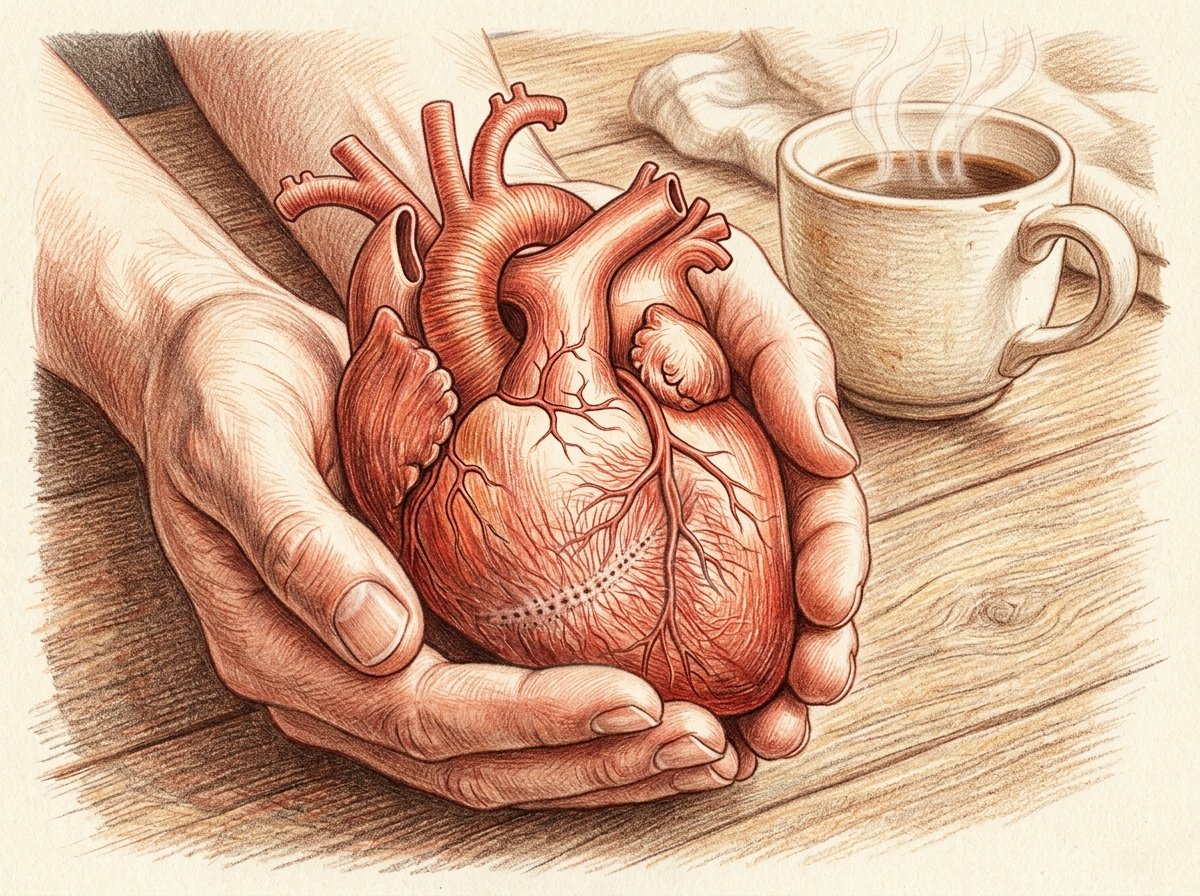
Researchers at the University of Sydney have overturned a decades-old assumption in medicine: the human heart muscle, long believed to be incapable of self-repair, can actually produce new muscle cells after a heart attack. The world-first study, published in the journal Circulation Research and widely reported this week, used living heart tissue collected from patients during bypass surgery — not from donated post-mortem tissue — and found direct evidence that heart muscle cells, called cardiomyocytes, can re-enter cell division and begin replacing themselves after injury. A heart attack can destroy up to one-third of the cells in the human heart, and currently the only cure for the resulting heart failure is a transplant.
Why this matters: Cardiovascular disease is the single leading cause of death worldwide, and heart failure — where the heart can no longer pump effectively after damage — currently has no cure except a transplant, an option available to only a tiny fraction of patients globally. If scientists can amplify the heart’s natural repair response, future therapies might one day reverse the damage a heart attack leaves behind — something that has never been possible before.
💡 Did You Know? — The Heart Was the One Organ Scientists Thought Could Never Grow Back
For most of your body, cell replacement is a normal part of life — your skin renews itself roughly every month, your red blood cells are replaced every 120 days. But the heart was always considered the exception. Once you were born, scientists believed your heart cells were the ones you’d have forever — and that when they died, they stayed dead. That assumption was based on the fact that heart cells almost never divide in adult humans, unlike, say, liver or skin cells. The new discovery shows that the heart does respond to injury by attempting mitosis — the process where one cell splits into two — it’s just doing it at a rate too low to fully repair itself. Think of it like a city that has firefighters, but not quite enough of them to stop a fire once it really takes hold. The discovery means scientists now know the system exists — and the goal is to find ways to send in reinforcements.
🔑 New Words & Ideas
- Heart attack (myocardial infarction) — a medical emergency in which blood flow to part of the heart is suddenly blocked, causing heart muscle cells to die from lack of oxygen.
- Cardiomyocytes — the specialised muscle cells that make the heart contract; until this discovery, adult human cardiomyocytes were believed to be permanently post-mitotic, meaning they could not divide.
- Mitosis — the biological process by which one cell copies itself and splits into two identical daughter cells; the fundamental mechanism behind the heart’s newly discovered repair response.
Sources: ScienceDaily – University of Sydney · The University of Sydney
02. Every Bird on Earth Is Singing in the Same Eight Words
Scientists in France analysed more than 116,000 birdsong recordings from 3,160 species — over 60% of all bird species on the planet — and made a quietly staggering discovery: despite the extraordinary variety of birdsong across the world, almost all of it is assembled from just eight basic acoustic motifs. These building blocks include three types of trill, three types of whistle, harmonic notes, and more chaotic patterns. Published in the journal Science in July 2026, the study used AI to process this vast library of recordings and then linked each species’ song style to the acoustic habitat it evolved in — finding that the environment birds live in shapes the song they sing far more than scientists expected.
Why this matters: The next time you hear a bird singing outside your window, you’re not just listening to noise or even just to nature — you’re hearing one of eight fundamental musical grammars that evolution has been refining for tens of millions of years. Understanding the connection between habitat and birdsong also gives researchers a new tool for monitoring how animal communication changes as forests are destroyed or cities expand.
💡 Did You Know? — Birds Don’t Improvise. They Remix Eight Ancient Patterns.
Imagine if every piece of music ever written — jazz, classical, pop, opera — turned out to use only eight fundamental chord shapes, mixed and layered differently. That’s essentially what researchers found in the bird world. A bird in a dense tropical rainforest tends to use simple, flat whistles, because complex sounds scatter and get swallowed by thick vegetation before they reach another bird. A bird in an open temperate woodland uses faster, more intricate combinations — trills on top of harmonics — because clear air carries complex signals well and complex songs carry more mating information. The habitat isn’t just a backdrop; it’s literally shaped what sounds birds evolved to make. Each species uses roughly five of the eight motifs on average, and nearly two-thirds of all songs combine multiple motifs into something more complex. Evolution, it turns out, is working with a very short menu.
🔑 New Words & Ideas
- Acoustic motif — a basic, recurring sound pattern (like a trill or a flat whistle) that serves as a building block in birdsong, the way a musical chord is a building block in a piece of music.
- Acoustic habitat — the sound environment of a place — how far sounds carry, how much they scatter, how much background noise exists — which shapes which kinds of animal calls evolve there.
- Passerine — the order of birds that contains more than 60% of all bird species, commonly called “perching birds” or “songbirds”; includes sparrows, robins, finches, warblers, and thousands of others.
Sources: Phys.org – Birdsong motifs study · Audubon Magazine – Eight musical elements
03. Saturn Quietly Grew a 10-Sided Shape at Its South Pole While Nobody Was Looking
A study published in the journal Science Advances on 2 September 2026 — and formally presented at the Europlanet Science Congress in The Hague this week — confirmed that the Hubble Space Telescope has discovered a massive decagon encircling Saturn’s south pole. The discovery was led by planetary scientist Agustín Sánchez-Lavega of the University of the Basque Country, Spain, with co-authors from NASA and UC Berkeley. Saturn now has large geometric atmospheric wave patterns at both poles: the hexagon at the north, discovered by the Voyager spacecraft more than 40 years ago and still stable today, and this newly confirmed ten-sided counterpart in the south that appears to have formed sometime between 2017 and 2023 — and is still growing stronger. Each side of the decagon is longer than 16,700 kilometres — roughly four times the coast-to-coast width of the United States.
Why this matters: This discovery doesn’t just mean Saturn has a second geometric curiosity — it suggests that geometric shapes forming at the poles of gas giants may be a general rule of physics, not a weird accident. Scientists are now asking whether similar patterns might exist at the poles of Jupiter, Uranus, and Neptune, and nobody has looked for them carefully enough until now.
💡 Did You Know? — Gas Planets Grow Geometry, and Here’s Why
Saturn isn’t solid — it’s a swirling ball of gas, mostly hydrogen and helium. Near its poles, different bands of that gas spin at different speeds. Think of it like stirring two layers of syrup in a jar at different rates — where the fast layer meets the slow layer, a wave forms at the boundary. On Saturn, that boundary wave is enormous and perfectly regular, and the number of sides it develops depends on the physics of how the two gas streams interact. The decagon extends through multiple layers of Saturn’s atmosphere, meaning it isn’t just a surface pattern — it goes deep. The fact that Saturn can produce two different geometric shapes — six sides in one hemisphere, ten in the other — suggests the conditions at each pole differ subtly, and that planetary atmospheres are far more structured than the swirling chaos they appear to be from here.
🔑 New Words & Ideas
- Decagon — a geometric shape with exactly ten sides; the pattern now confirmed encircling Saturn’s south pole, embedded in one of the planet’s powerful wind streams.
- Atmospheric wave — a large, regular undulation in the atmosphere of a planet, similar to a wave in the ocean but made of gas; when these waves are very regular and large, they can form visible geometric patterns.
- Jet stream — a fast-moving band of wind at a specific latitude or altitude; Saturn’s jet streams are far faster than Earth’s and are the mechanism driving both of its geometric polar shapes.
Sources: ScienceDaily – Saturn decagon · Smithsonian Magazine – Decagon at Saturn’s south pole
04. Archaeologists Found a Hidden City Beneath the World’s Oldest Salt Mine
Archaeologists from the Natural History Museum Vienna (NHM) have discovered an extensive network of previously unknown Iron Age mining chambers stretching for at least 300 metres beneath the prehistoric salt mine of Hallstatt, Austria — the oldest continuously worked mine in the world, with evidence of salt extraction going back over 7,000 years. Reported by Heritage Daily on 11 September 2026 and formally presented at the “Archaeology on the Mountain” event at Hallstatt this weekend (12–13 September), the newly identified chambers date to the sixth century BC, during the Hallstatt Culture (approximately 800–400 BCE) — the civilisation so significant that archaeologists named an entire era of European prehistory after this single site. Salt at the time was so valuable it was called “white gold” and functioned as a form of currency.
Why this matters: The Hallstatt mine is remarkable not just for its age, but for what it preserves. Because salt is a natural preservative, organic materials — wooden tools, leather shoes, textiles, even food — have survived inside these tunnels for thousands of years in near-perfect condition. The newly discovered chambers contain mining debris up to nine metres deep, meaning researchers can now reconstruct not just where Iron Age miners worked, but what they wore, what they ate, and even — through ancient DNA preserved in human waste — who they were.
💡 Did You Know? — Salt Was Once Worth More Than Gold, and It Built Civilisations
Today salt is so cheap and abundant that we barely think about it. But for most of human history, salt was a critical, scarce, and immensely valuable resource. It preserved food — allowing communities to store meat and fish through winter — and it was essential for trade across vast distances. The word “salary” comes from the Latin salarium, a payment given to Roman soldiers to buy salt, which is also where we get the phrase “worth their salt.” The people of Hallstatt became extraordinarily wealthy because they controlled one of Europe’s most productive salt deposits. They built trade routes, developed sophisticated technology, and created an art style so distinctive that it defined an entire archaeological period — the Hallstatt Period — across a continent. The newly found chambers suggest the operation was even larger and more organised than anyone realised.
🔑 New Words & Ideas
- Salt mine — an underground extraction site where salt (sodium chloride) is mined from rock; the Hallstatt mine has evidence of use going back over 7,000 years, making it the world’s oldest.
- Iron Age — the period of human history, roughly 1200–550 BCE in Europe, when iron tools and weapons replaced bronze ones; the Hallstatt Culture represents one of its most sophisticated early phases.
- Hallstatt Culture — a Central European civilisation centred in Austria from around 800–400 BCE, so named because the archaeological site at Hallstatt is so rich and well-preserved that it became the defining reference point for this era.
Sources: Heritage Daily – Vast Iron Age mining complex at Hallstatt
05. Your Morning Coffee Is Doing Something Inside Your Cells That Nobody Understood Until Now
Scientists at Queen Mary University of London have discovered that caffeine — the world’s most widely consumed neuroactive compound — activates a cellular energy system called AMPK (AMP-activated protein kinase), which is involved in stress resistance, DNA repair, and growth regulation. Published in the journal Microbial Cell and highlighted widely in science media this week, the research was conducted in fission yeast, a single-celled organism that shares fundamental biological machinery with human cells and is widely used in ageing research. What surprised the researchers was that caffeine doesn’t act where they expected — not directly on the growth regulator TOR (Target of Rapamycin), which the same team had previously linked to caffeine’s longevity effects — but on an even more ancient cellular system upstream of it.
Why this matters: Billions of people consume caffeine every day, and epidemiological studies have long hinted at connections between regular coffee or tea consumption and lower rates of certain age-related diseases. This research doesn’t prove that coffee makes you live longer — but it identifies a specific biological mechanism that may help explain why those associations keep showing up, and opens a path toward drugs that target the same pathway more precisely.
💡 Did You Know? — Every Cell in Your Body Has a Fuel Gauge, and Caffeine Appears to Flip It
Inside every living cell, there is a molecular sensor whose job is to detect when energy is running low and respond accordingly. Think of it as a fuse box that trips when the power grid is under strain — and when it trips, it switches on a whole cascade of repair and conservation responses: it helps cells manage stress, fix damaged DNA, and slow down unnecessary growth. That sensor is AMPK. In humans, AMPK is also the target of metformin, a widely prescribed diabetes drug now being studied for its possible effects on the biology of ageing itself. What this research suggests is that caffeine appears to activate the same switch — not by crashing your cells’ energy supply, but by mimicking the signal that would normally trigger AMPK. Whether that translates from yeast to humans, and at what doses, remains an open question. But for something billions of people drink every morning without thinking about it, the finding is quietly remarkable.
🔑 New Words & Ideas
- Caffeine — a naturally occurring stimulant found in coffee, tea, and many other plants; classified as a neuroactive compound because it crosses into the brain and affects nervous system activity, primarily by blocking adenosine receptors that promote drowsiness.
- AMPK (AMP-activated protein kinase) — a cellular energy sensor present in nearly all living things; when it detects low energy levels, it triggers processes that help the cell cope with stress, repair DNA, and conserve resources — all processes closely linked to healthy ageing.
- DNA repair — the set of biological processes by which a cell identifies and fixes damage to its genetic code; errors that go unrepaired can accumulate over time and contribute to cancer, neurodegeneration, and other age-related conditions.
Sources: ScienceDaily – Caffeine and AMPK · Queen Mary University of London research
Researched with AI assistance. Always a good idea to check the linked sources yourself.